
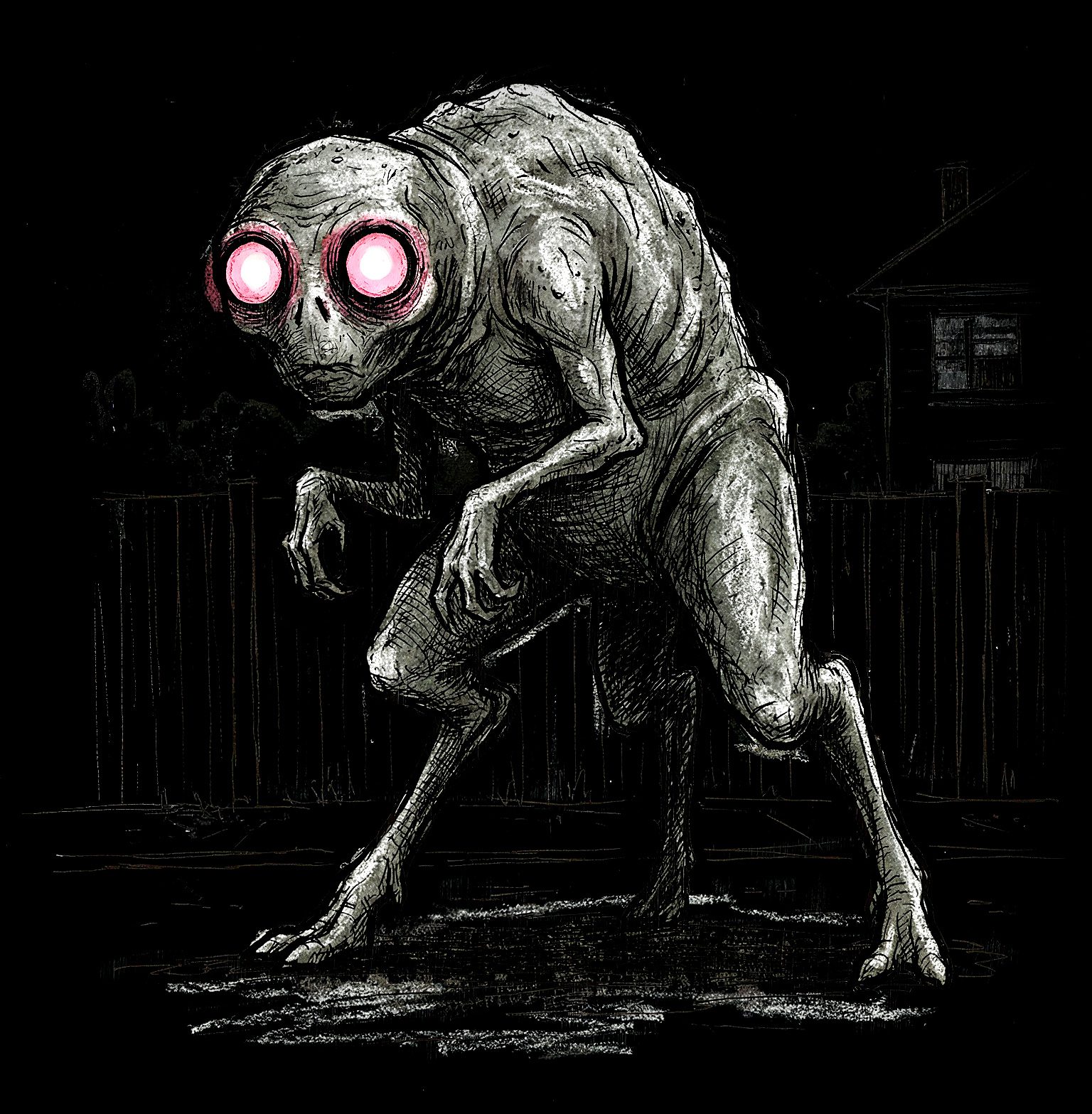
Enfield Horror
Type: Humanoid / animal anomaly
Region: Enfield, Southern Illinois, United States
Description: The Enfield Horror, also known as the Enfield Monster, entered public attention in April 1973 after a sudden cluster of alarming encounters in a rural Illinois community. Witnesses described a compact, grayish creature approximately 4.5 feet tall, marked by an unsettlingly asymmetrical anatomy: three legs, short forelimbs, and large glowing pinkish eyes often compared to flashlights. Its skin was reported as smooth or leathery rather than fur-covered, giving it an unnatural, almost unfinished appearance. Notably, sightings occurred near homes, yards, and fence lines rather than deep wilderness, creating the disturbing impression of a creature intruding directly into human spaces.
Behavior: Reports emphasize sudden, startling encounters rather than distant observation. The creature appeared abruptly, frightened witnesses, and fled with extraordinary jumping ability, covering large distances in only a few bounds. A high-pitched, piercing screech was frequently reported, contributing to panic and disorientation. Responding law enforcement officers noted unusual footprints described as dog-like yet inconsistent with known animal tracks. As fear spread, ordinary nighttime sounds were increasingly interpreted as signs of the creature’s return, amplifying community anxiety.
Cultural Significance: The Enfield Horror became one of the most widely recognized cryptid cases of the 1970s due to rapid media coverage and the involvement of multiple witnesses, including police officers. Armed searches and national news reports transformed a brief series of sightings into a lasting piece of American folklore. Although the encounters subsided within weeks, the creature’s bizarre three-legged form set it apart from conventional cryptids and secured its place in popular culture. It continues to appear in books, documentaries, podcasts, and television programs as a classic example of a modern panic cryptid, illustrating how fear, media attention, and community psychology can quickly shape enduring legends.